
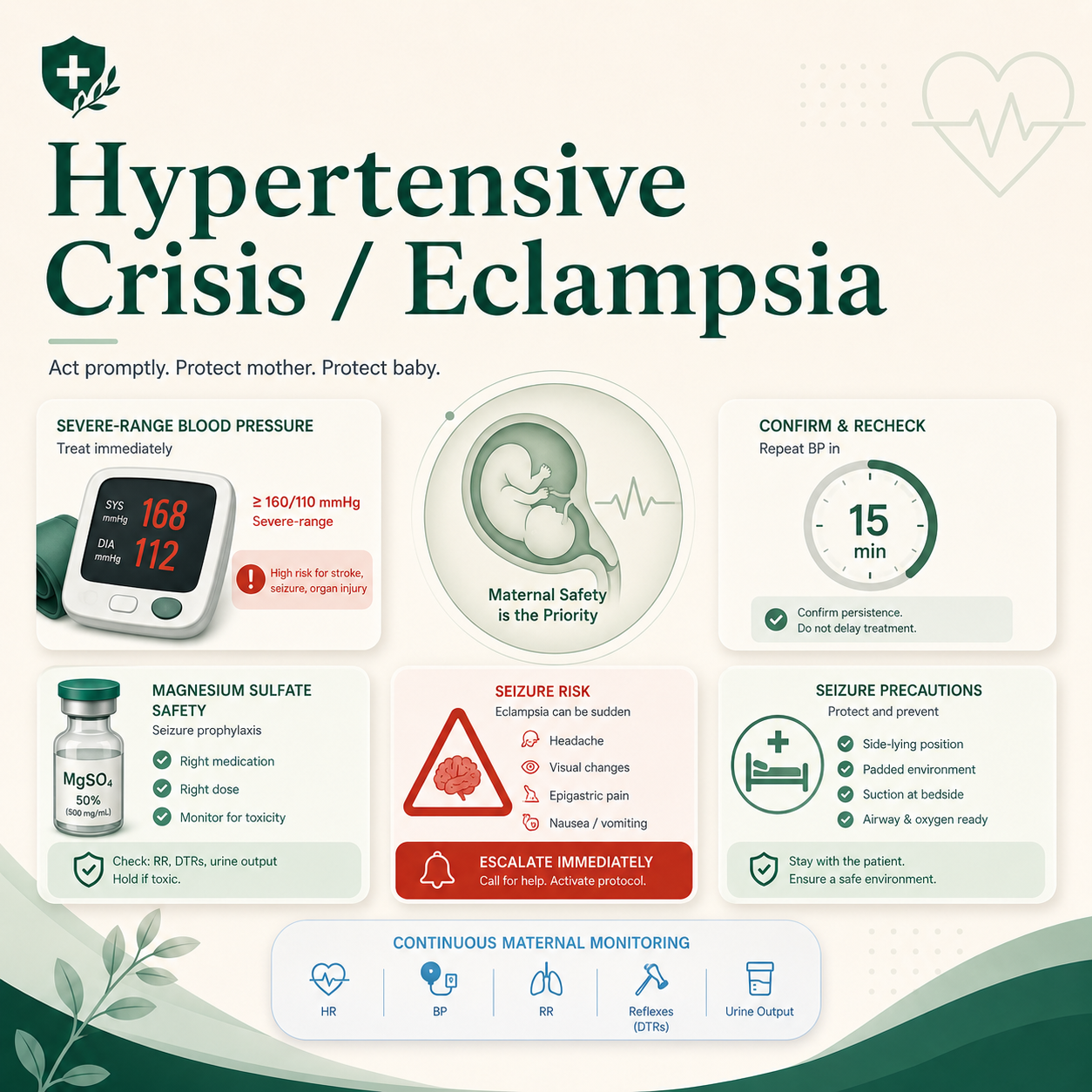
Your postpartum patient''s blood pressure was 138/86 at the start of your shift. Two hours later it''s 148/92. She mentions a headache — but she also just had a baby and hasn''t slept. The reading isn''t severe. Nothing about the room says emergency.
This is exactly the moment hypertensive emergencies are missed: not because the nurse can''t recognize 172/112, but because no single reading ever looked that bad.
Look for a direction, not a number
A 148 that used to be a 138 is not "still under 160." It''s a climb. The question that changes your shift is not "is this reading severe?" but "what has this pressure been doing for the last two hours — and what is it doing alongside her symptoms?"
Any of these next to a climbing pressure outranks the number on the cuff:
- New or worsening headache, especially one unrelieved by analgesics
- Visual changes — spots, flashing lights, blurring
- Right-upper-quadrant or epigastric pain
- Brisk reflexes or clonus
The threshold that starts a clock
A severe-range reading — 160 systolic or 110 diastolic — that persists on recheck in about 15 minutes is not a "keep watching." It''s a hypertensive emergency, and the treatment window is measured in minutes, not hours. That recheck interval is the clock; knowing it changes how you phrase every call you make before the threshold is crossed.
Escalate before the threshold, with a script
Word for word, on the phone:
"Dr. ___, this is ___ calling about Room ___, G_P_, [X hours] postpartum. Her pressure has climbed from 138/86 to 148/92 over two hours and she has a new headache. I''m going to recheck in 15 minutes, and if she reaches severe range I''ll be calling you for antihypertensives. Is there anything you want in place now?"
That last sentence matters. You''ve named the plan, started the clock out loud, and made the next call expected instead of apologetic.
Chart the trend, not just the readings
Times, values, and symptoms in sequence — plus who you notified, when, and what the response was. A note that shows a climb, a recheck interval, and a notification time is a note that protects you. A list of isolated readings is not.
The one-line version
Trend + symptom > single number. Severe range that persists ~15 minutes = the clock has started.
This is education, not medical advice — your facility''s policy, provider orders, and clinical judgment always come first.
Want the same recognize → escalate → document walkthrough for all eight major OB emergencies? Download the free OB Emergency Command Manual.