Loading
Matriarch CommandOB Emergency Readiness
Free download · New & new-to-L&D nurses





Your first OB emergency won’t wait for you to feel ready. Know the first move before the room turns to you.
A free field guide that turns the emergencies you're quietly terrified of into a sequence you can actually run — recognize, escalate, document — before you're the one in the room.
Built with L&D nurses & OB physicians — for the nurses in the room when it happens
- The red flags for the OB emergencies you'll be expected to catch
- Word-for-word scripts for calling the provider when your voice is shaking
- What to do in the first 90 seconds — before help arrives
- How to chart it so your note protects you and your patient
Created by L&D nurses & OB physiciansAligned to national maternal-safety standards
Free · instant downloadBuilt by clinicians
Created by L&D nurses and OB physicians — aligned to the standards hospitals use.




Content is aligned to publicly available maternal-safety guidance. Not affiliated with or endorsed by these organizations.
Every new L&D nurse knows this feeling
You know the medicine. You're still afraid you'll freeze.
Orientation teaches you the unit. It doesn't fully prepare you for the moment the monitor changes, the room fills up, and everyone assumes you know exactly what to do next.
The fear isn't a knowledge gap — it's not having run the sequence enough times for it to feel automatic. That's what separates the nurse who hesitates from the one who moves.
This manual gives you that sequence on paper for every emergency you'll face, so your first real one feels like your tenth.
Day 1 ready
You don't need years on the unit to respond well. You need the first move rehearsed — that's what this gives you.
Who made this
Written by a labor & delivery nurse — not a content team.
Maloree walks you through the whole thing in 90 seconds — the modules, the practice arena, the downloads, and the pocket cards. Filmed on her own phone, nothing staged.
The free manual is the short version of what she teaches inside Matriarch Command. Take it first — it stands on its own.
Get the free manual
L&D nurse · founder
Inside the app
Matriarch Command, right on your phone.
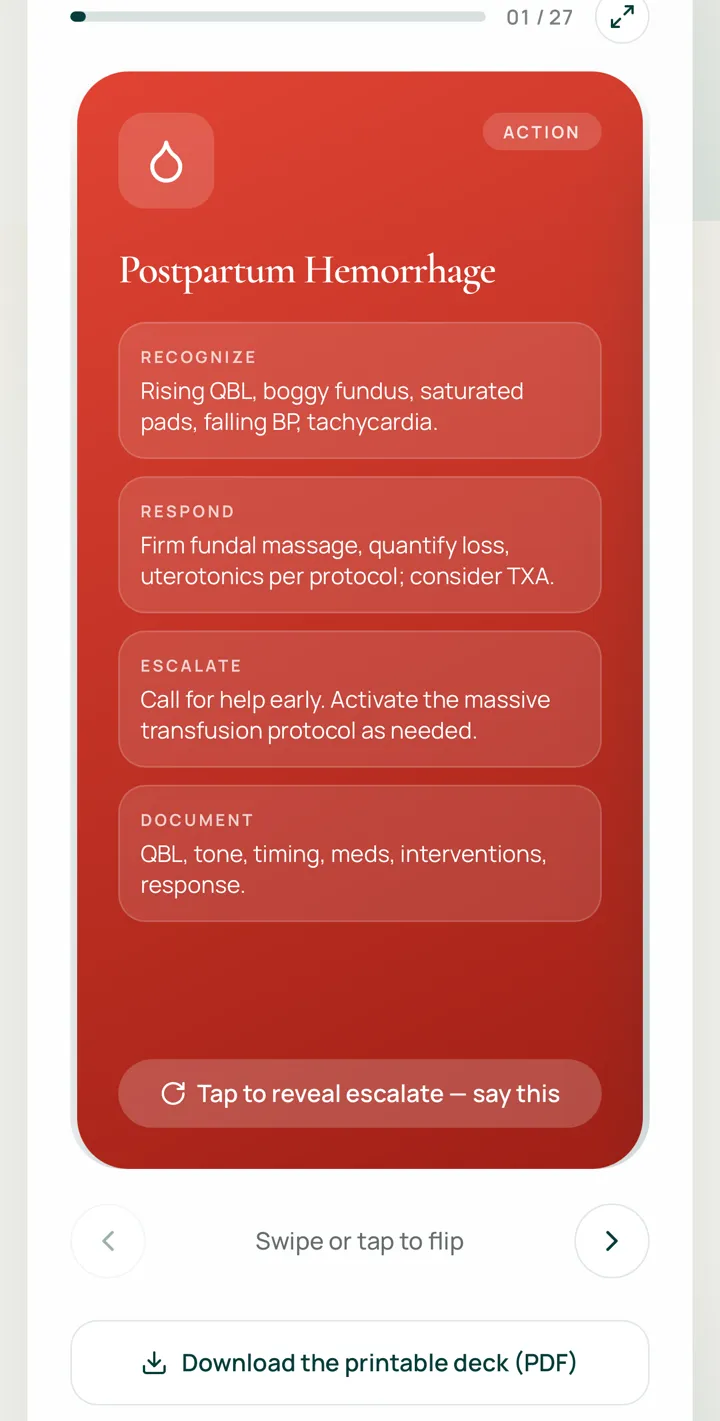
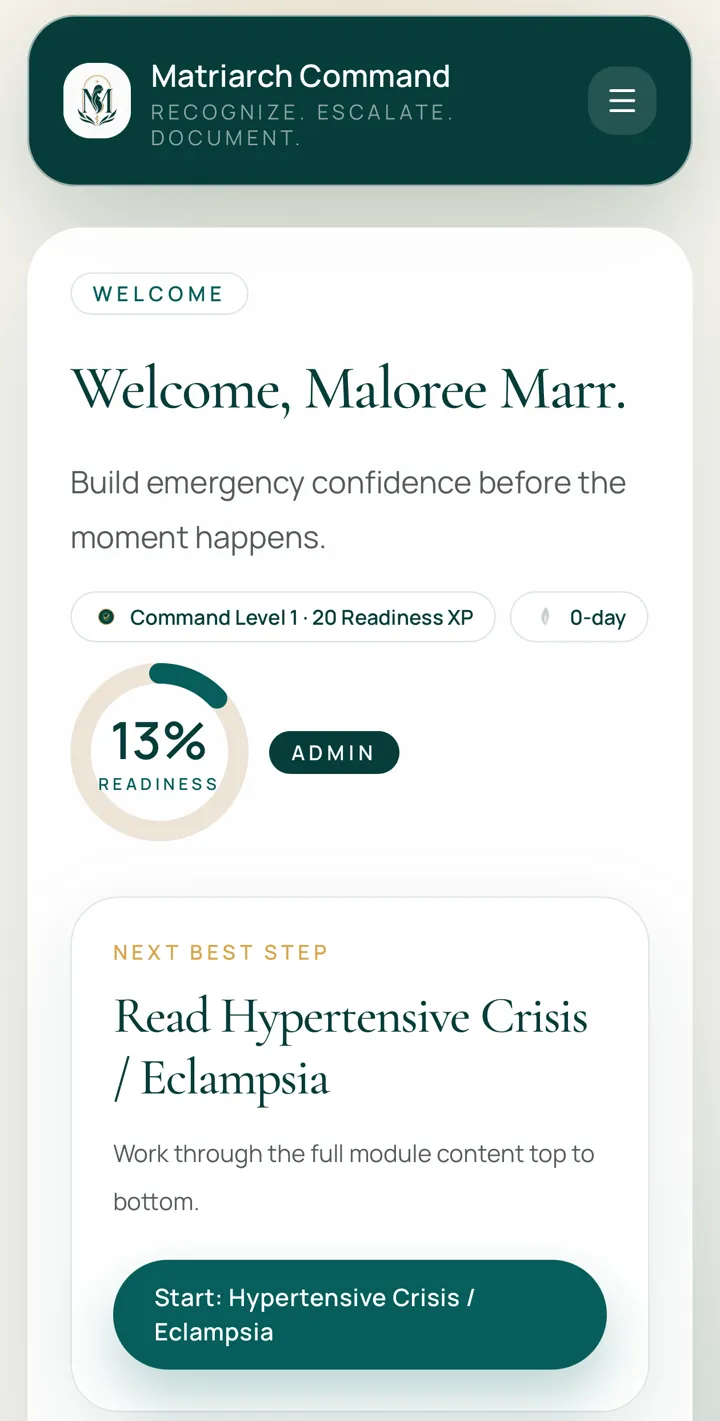
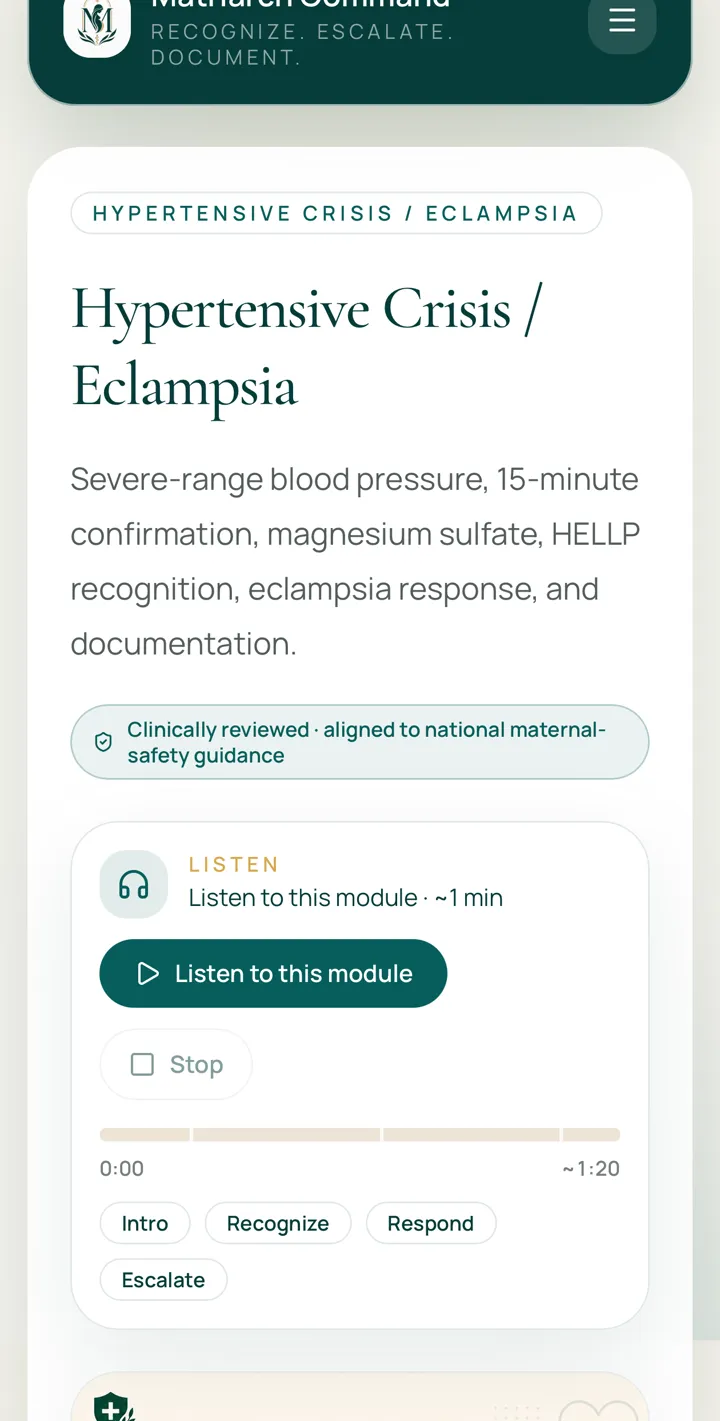
Real screens from the platform — the dashboard with your readiness score, the emergency modules with listen-along audio, and the Pocket Command Cards with the exact escalation words, offline. This is the paid Starter Kit the free manual comes from.
Inside the manual
The playbook orientation didn't hand you
The OB Emergency Command Manual is a free field guide to the emergencies every L&D nurse is expected to handle — written so a nurse on week three can follow it.
The emergencies, decoded
Hemorrhage, preeclampsia, shoulder dystocia, cord prolapse and more — each broken into recognize, escalate, document.
First-90-seconds moves
Exactly what to do before the provider and rapid response arrive, in order.
Scripts for the hard calls
SBAR language for paging the provider and speaking up to the team — even when you're nervous.
Red flags you can't miss
The early signs that separate 'keep watching' from 'act now,' in plain language.
Charting that protects you
Documentation prompts so your note reflects what you did — and covers you when it's reviewed.
Built for between patients
Short and phone-friendly. Review one emergency on a break, not a textbook at home.


Made for new nurses who want their first emergency to feel like their tenth.
Built with practicing L&D nurses and OB physicians — written so a nurse on week three can run it.
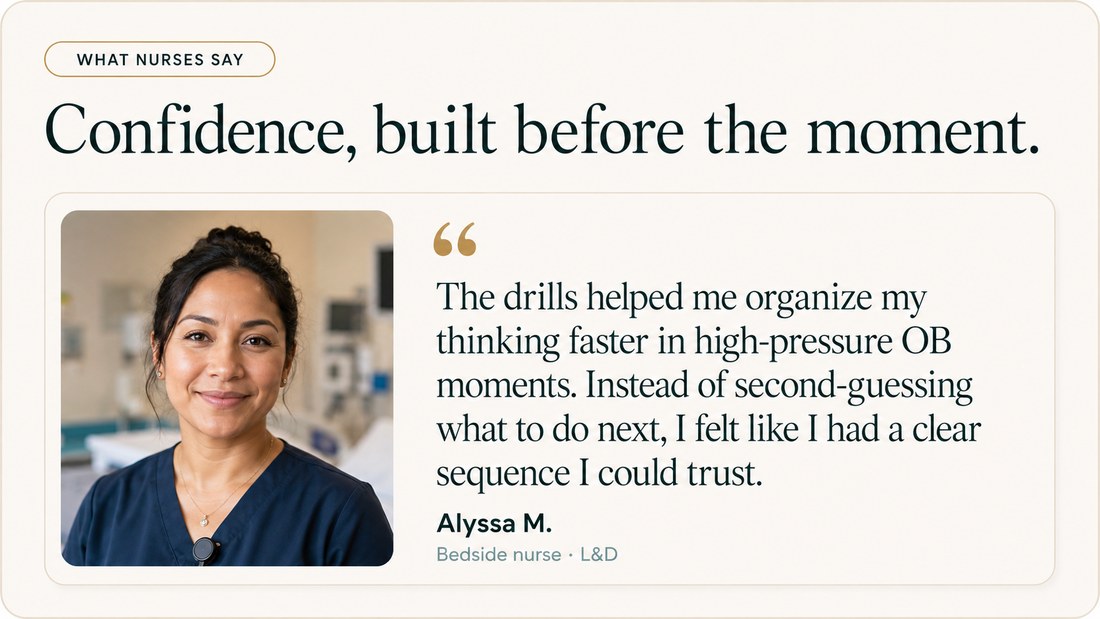
From nurses like you
What L&D nurses say about Matriarch Command.
Built for the bedside
- Built around the recognize–escalate–document framework taught across AWHONN and ACOG guidance.
- Plain language for nurses still building confidence — no gatekeeping, no jargon walls.
- An educational resource — always follow your facility policy, provider orders, and clinical judgment.
- Free to keep. No course, no credit card.

Stop rehearsing the panic. Rehearse the response.
Get the free OB Emergency Command Manual and walk into your next shift with the first move already in your hands. Two fields, 15 seconds, instant access.
Send me the free guide nowFree · instant download · no credit card
Free manualInstant · no spam
Send me the free guide now